Insulin Resistance in Midlife Women: Signs, Tests and What to Do

Medical Disclaimer: This article is for general informational purposes only and does not constitute medical advice. Always consult a qualified healthcare professional about your individual circumstances before making changes to your health management.
Quick Answer
Insulin resistance is when your cells stop responding properly to insulin, so your body produces more of it to keep blood sugar stable. In midlife, declining oestrogen makes this more likely, and it shows up as abdominal weight gain, energy crashes after meals, carb cravings and brain fog. A standard fasting glucose test can look normal for years while it’s developing. The tests that actually catch it are fasting insulin and a calculated HOMA-IR score, and it’s one of the most reversible metabolic changes of perimenopause.
If your weight won’t shift no matter what you do, if an afternoon slump hits most days like a wall, or if cravings for carbs feel bigger than willpower, and you’ve already been told your blood sugar is “fine,” insulin resistance is worth ruling in or out.
It develops quietly, often for years, before it shows up on a standard blood test. That’s because most GPs check fasting glucose, and glucose can sit in a normal range long after your pancreas has started working overtime to keep it there. The number that tells the real story, fasting insulin, isn’t part of a routine panel.
This article walks through why insulin resistance becomes more common from your forties onward, the signs worth paying attention to, the specific tests to ask for, and the everyday changes that make the biggest difference. This is less about willpower than about understanding what’s actually happening in your body, so you can work with it rather than against it.
What Is Insulin Resistance?
Insulin is the hormone that allows glucose to move from your bloodstream into your cells to be used for energy. When cells become resistant to insulin’s signal, glucose struggles to get in, so your pancreas produces more insulin to compensate. This state, elevated insulin alongside blood sugar that still looks normal, is called compensatory hyperinsulinemia, and it’s the earliest and most common stage of insulin resistance.
Why Insulin Resistance Becomes More Common in Midlife
Oestrogen does far more than regulate your cycle. Its receptors sit on cells throughout the body, and when it binds to them, it switches on genes involved in metabolism, fat burning and how efficiently your cells respond to insulin. As oestrogen fluctuates through perimenopause and then declines, that signalling weakens.
The practical result is that your cells become less responsive to insulin, so your body needs to produce more of it just to keep blood sugar in a normal range.1
Insulin is often described as a storage hormone: alongside moving glucose into cells, it also promotes fat storage, particularly around the abdomen. Higher circulating insulin pushes your body further into fat-storage mode, which drives hunger, cravings and the kind of visceral weight gain that collects around the middle rather than the hips.
Two other midlife shifts compound this. Muscle mass, which acts as a glucose reservoir and absorbs blood sugar without needing insulin at all, starts declining from your thirties and drops faster without regular strength training. And cortisol, which tends to run higher when you’re juggling work, family and disrupted sleep, raises blood sugar directly, asking insulin to work harder to bring it back down. None of these systems operate in isolation. Oestrogen decline, muscle loss and elevated cortisol all feed into the same problem from different directions.
The Signs of Insulin Resistance in Midlife Women
Insulin resistance rarely announces itself with one obvious symptom. It tends to show up as a cluster of things that seem unrelated until you see the pattern.
Energy that crashes after meals
A carbohydrate-heavy meal sends blood sugar up quickly, and the body responds by releasing a surge of insulin. When that response overshoots, blood sugar drops too far about two hours after eating, producing a wave of fatigue, heaviness and an urgent craving for something sweet. That wave is a blood sugar crash rather than genuine hunger.
Cravings specifically for carbohydrates and sugar
When insulin resistance impairs your ability to access stored fat for fuel, your body defaults to demanding the fastest energy source available, which is why craving bread, pasta or chocolate reflects your brain signalling that it can’t reach the fuel it needs, rather than a lack of discipline.
Weight collecting around the abdomen
Declining oestrogen shifts fat distribution toward the abdomen. This visceral fat is both a consequence of insulin resistance and an active driver of it, releasing inflammatory compounds that further impair how your cells respond to insulin. The two reinforce each other in a loop that cutting calories alone rarely breaks.
Darkened, velvety skin on the neck, underarms or groin
This is called acanthosis nigricans, and it’s one of the more specific visible markers of insulin resistance. It develops because high circulating insulin causes skin cells in areas of friction to grow faster than usual, and studies grading its severity have found a clear correlation with fasting insulin, fasting glucose and HOMA-IR scores.2
It’s worth mentioning to your doctor if you notice it.
Brain fog that tracks with meals
After a blood sugar spike and the drop that follows, the body releases adrenaline to stabilise itself, which can bring on a racing heartbeat, clamminess and sudden anxiety, followed by cognitive fog. Words go missing, concentration won’t hold and a mental heaviness settles in reliably after eating. Together, these point to a blood sugar story rather than an anxiety one.
If several of these feel familiar, it’s worth investigating further, even if a previous blood test came back “normal.”
Why a Normal Glucose Test Doesn’t Rule It Out
Most women have had fasting glucose checked, and some know their HbA1c, the three-month average of blood sugar. Very few have had fasting insulin measured, and it isn’t part of a standard panel.
Insulin resistance develops silently for years before glucose moves out of range. While glucose looks perfectly normal on paper, your pancreas may already be compensating hard, producing far more insulin than it should need to just to keep glucose steady.
By the time fasting glucose actually rises, that process has often been building for a decade or more.
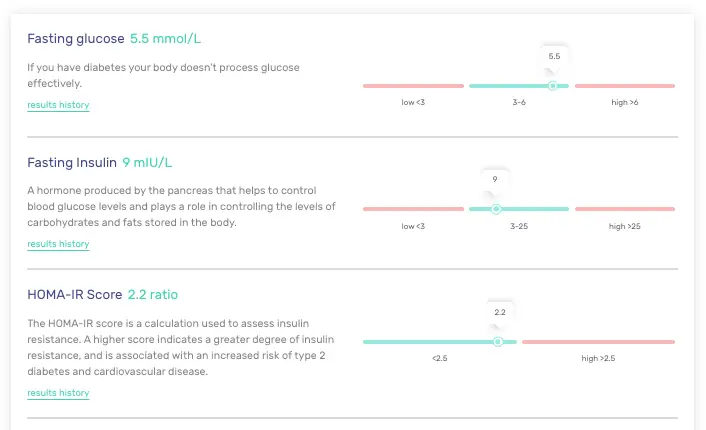
The HOMA-IR score combines fasting insulin and fasting glucose into a single estimate of how well your body is responding to insulin. It isn’t a diagnostic test on its own, but it’s one of the most useful early indicators available. A woman with a fasting glucose of 5.1 mmol/L and a fasting insulin of 15 μU/mL can look metabolically unremarkable on a standard panel, even while her pancreas is compensating hard behind the scenes. Without testing insulin directly, that effort stays invisible.
The Tests to Ask For
If the signs above sound familiar, take this list to your GP:
-
Fasting glucose
-
Fasting insulin
-
HOMA-IR, calculated from the two results above
-
HbA1c, for a longer-term picture of blood sugar control
As a general guide, a fasting insulin result under 6 μU/mL is considered a healthy target, though the trend over time matters more than any single number. Insulin rising while glucose still holds steady is the early signal worth catching, well before anything shows up as prediabetes or type 2 diabetes.
Catching insulin resistance early makes it considerably easier to reverse. If you’re reading this already diagnosed with prediabetes or type 2 diabetes, it remains reversible at any stage with the right support.
What You Can Do About Insulin Resistance
The encouraging part of this picture is that insulin resistance responds well to targeted, sustainable changes. None of the following require an overhaul.
Move after eating
Working muscle takes up glucose directly from the bloodstream without needing insulin at all. A structured workout isn’t required. Hanging out washing, taking a short walk, using a standing desk or climbing a flight of stairs in the thirty to sixty minutes after eating reduces the glucose spike before it fully builds. Over weeks, this adds up to a measurable difference in fasting insulin and HOMA-IR.
Tell true hunger apart from cravings
True hunger is a physical sensation below the neck, a grumble in the stomach, and it’s a sign that lipolysis, the process of drawing on fat stores for fuel, is beginning. Waiting for that signal and sitting with it for ten to fifteen minutes before eating gives your body a chance to use fat stores rather than defaulting straight to glucose. A craving, by contrast, sits above the neck: a taste in the mouth, an image of a specific food. It tends to respond better to movement, a short distraction or a small protein snack than to giving in outright.
Rebuild rather than remove carbohydrates
The goal isn’t elimination but substitution. Replacing the most glucose-spiking foods, such as white bread, pasta and chips, with combinations that include protein, vegetables and fibre slows digestion and blunts the blood sugar rise. Carbohydrates aren’t the enemy at this stage of life. Your body simply needs less of the fast-releasing kind and more of the slow-releasing kind.
Prioritise strength training
Building and maintaining muscle is one of the most effective long-term levers against insulin resistance, because muscle absorbs glucose without needing insulin’s help. Regular resistance training, paired with adequate protein intake, is more effective at protecting your metabolic health in midlife than cardio alone.
Ask about myo-inositol
Myo-inositol helps cells respond more readily to insulin’s signal, meaning your body needs to produce less of it to manage blood sugar. In a placebo-controlled trial of postmenopausal women with metabolic syndrome, six months of myo-inositol supplementation alongside diet significantly improved HOMA-IR scores compared with diet alone.3
It’s generally well tolerated and worth discussing with your doctor once the foundational habits above are in place.
These five habits work best together, and even small, consistent shifts in two or three of them tend to move fasting insulin and HOMA-IR faster than trying to overhaul everything at once. If the symptoms described above sound familiar but you’re still not sure they fit the pattern, it’s worth taking them to your GP alongside a request for the specific tests outlined earlier, rather than waiting for a routine blood sugar reading to flag it.
Frequently Asked Questions
Can you have insulin resistance with normal blood sugar?
Yes, and it’s common. Fasting glucose can stay within a normal range for years while your pancreas compensates by producing more insulin. This is why fasting insulin and HOMA-IR, not glucose alone, are needed to catch it early.
Is insulin resistance the same as prediabetes?
Not quite. Insulin resistance is the underlying mechanism, and prediabetes is a later stage where glucose has started to move outside the normal range. Insulin resistance can be present for years before glucose changes enough to meet the prediabetes threshold.
Why does insulin resistance get worse in perimenopause specifically?
Declining and fluctuating oestrogen weakens how your cells respond to insulin’s signal, while muscle loss and higher cortisol from stress and disrupted sleep compound the effect. The hormonal, metabolic and lifestyle pressures of this life stage tend to converge at the same time.
I'm eating well and exercising, so why isn't it improving?
This is one of the most common frustrations we hear, and it’s not a sign you’re doing something wrong. If insulin resistance is present, general “eat less, move more” advice often isn’t specific enough. The type of movement (strength training and post-meal walks), the composition of meals (protein and fibre paired with carbohydrates) and stress and sleep all matter more than calories alone at this stage.
What does acanthosis nigricans look like?
It appears as darkened, thickened, velvety skin, most often on the back of the neck, underarms or groin. It develops gradually and isn’t painful or itchy. If you notice it, it’s worth mentioning to your doctor alongside a request for fasting insulin testing.
Can insulin resistance be reversed?
Yes. It’s one of the more responsive metabolic changes in midlife, particularly when caught early. Movement after meals, resistance training, adjusting how carbohydrates are eaten, and supporting sleep and stress all contribute to measurable improvement in fasting insulin and HOMA-IR over weeks to months.
What fasting insulin level is considered healthy?
A commonly used target is under 6 μU/mL, though this is a guide rather than a strict cutoff. The trend over time, and how it sits alongside your fasting glucose and HOMA-IR, tells a more useful story than any single result.
The bottom line
If weight won’t shift despite doing “everything right,” if energy crashes after meals, or if carb cravings feel bigger than willpower, insulin resistance deserves a proper look rather than being written off as normal midlife change. A standard fasting glucose test can miss it for years, which is why fasting insulin and a calculated HOMA-IR score matter. The good news is that this is one of the most treatable metabolic shifts of perimenopause. Movement after eating, strength training, and rebuilding how you approach carbohydrates all make a measurable difference, often well before the scales move. Understanding what’s driving the pattern is what makes it possible to work with your biology instead of fighting it.
Citations
1 Marlatt KL, Pitynski-Miller DR, Gavin KM, Moreau KL, Melanson EL, Santoro N, Kohrt WM. Body composition and cardiometabolic health across the menopause transition. Obesity (Silver Spring). 2022;30(1):14-27. PMID: 34932890. View on PubMed
2 Patidar PP, Ramachandra P, Philip R, Saran S, Agarwal P, Gutch M, Gupta KK. Correlation of acanthosis nigricans with insulin resistance, anthropometric, and other metabolic parameters in diabetic Indians. Indian J Endocrinol Metab. 2012;16(Suppl 2):S436-7. PMID: 23565457. View on PubMed
3Giordano D, Corrado F, Santamaria A, Quattrone S, Pintaudi B, Di Benedetto A, D’Anna R. Effects of myo-inositol supplementation in postmenopausal women with metabolic syndrome: a perspective, randomized, placebo-controlled study. Menopause. 2011;18(1):102-104. PMID: 20811299. View on PubMed